Fibonacci
A scale that matches how complexity actually grows.
What is Fibonacci Estimation?
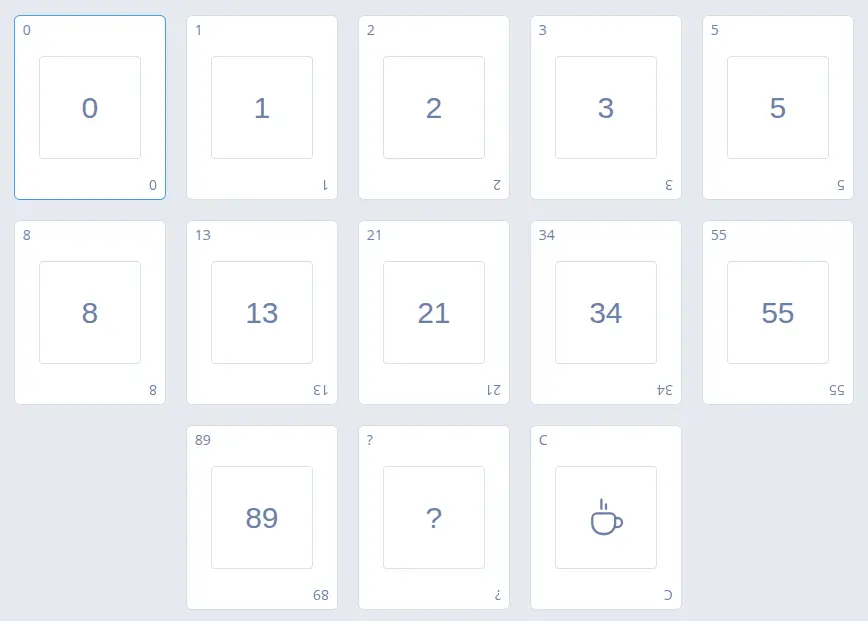
Fibonacci Estimation uses the Fibonacci sequence — 1, 2, 3, 5, 8, 13, 21, 34… — as the scale for story point estimation. Each number in the sequence is the sum of the two before it, which means the gaps between values grow larger as the numbers go up.
Team members assign Fibonacci numbers to backlog items based on relative complexity or effort — not hours or days. The focus is on comparing tasks to one another rather than pinning down an absolute value.
Why Use Fibonacci?
-
Reflects real-world uncertainty
Small tasks are relatively easy to tell apart. Large tasks are not. The growing gaps in Fibonacci numbers mirror this reality and discourage false precision on complex items.
-
Keeps discussions productive
Forcing a choice between 13 and 21 rather than any number in between surfaces meaningful disagreement. Teams debate substance, not decimal points.
-
Simple and widely understood
Fibonacci is the most common deck in agile teams worldwide. New team members and stakeholders pick it up immediately.
-
Improves over time
Teams that use Fibonacci consistently build intuition for what each number feels like, making future sprints more predictable.
How to Use Fibonacci Estimation
-
1.
Gather the team
Bring together everyone who will be doing the work — developers, designers, QA. The estimates will be better when all perspectives are in the room.
-
2.
Select and present an item
Pick a story from the backlog and read it aloud. Break down large items before estimating them — anything over 21 is usually a candidate to split.
-
3.
Vote simultaneously
Each person chooses a Fibonacci number privately. All votes are revealed at the same time to avoid anchoring.
-
4.
Reach consensus
Discuss any outliers, then re-vote until the team lands on a shared number. Record the final estimate and move to the next item.
-
5.
Repeat for the full backlog
Work through each item the same way. Keep sessions time-boxed — velocity over perfection.
Fibonacci in PlanPoker
PlanPoker includes a Fibonacci deck out of the box. Start a session and it is ready to use — no configuration needed.
- Fibonacci deck available by default alongside other popular decks
- Vote distribution charts to visualise where the team aligned or diverged
- Custom decks if you want to adjust the scale for your team
- Import your Jira backlog directly into the session